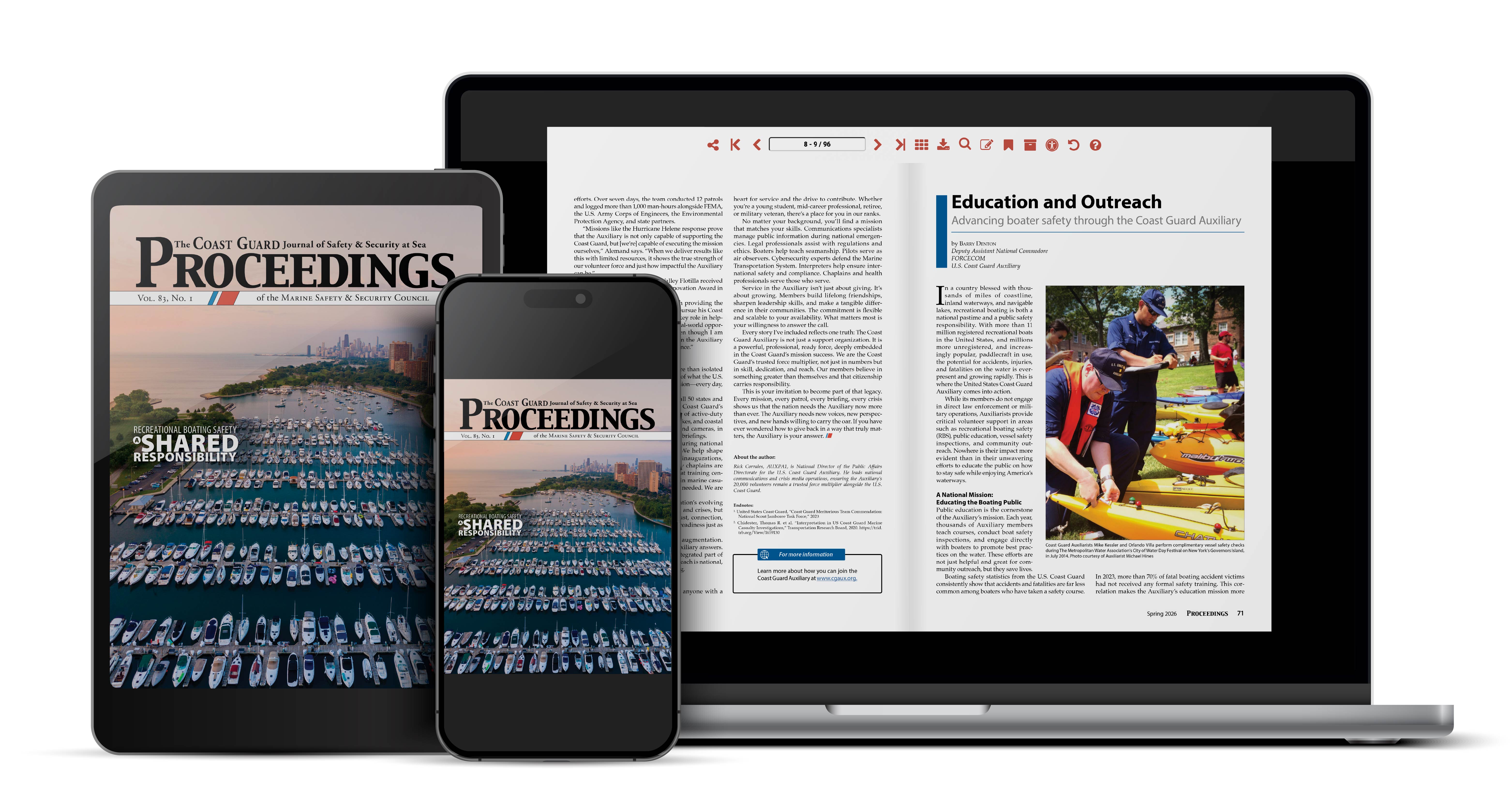
The Office of Auxiliary and Boating Safety is honored to showcase the National Recreational Boating Safety (RBS) Program and the volunteer work of the proud Coast Guard Auxiliary. A lot has changed since the programs were highlighted in Proceedings’ Fall 2016 edition and we welcome the opportunity to educate readers on the responsibilities of the 46 active duty, reservists, civilians, and contractors within the Boating Safety program.
The Boating Safety and Auxiliary divisions work together seamlessly to improve boating safety. Organized into three branches, the Boating Safety division includes 40 people whose primary functions are to assist the 56 state and territory Recreational Boating Safety Programs, administer grant funding, and ensure recreational boats and associated equipment are safe
The six Auxiliary division staff members support the outstanding work of more than 18,500 Auxiliarists. Annually, Auxiliarists volunteer more than 2 million operational and administrative support hours across missions like boating safety, culinary support, chaplain services, interpreter assistance, health services, and public affairs. In 2025 alone, they saved more than 180 lives and $6.9M in property.
Since 2016, 5,085 boating deaths, 20,049 injuries, and 34,079 accidents have been recorded. The Coast Guard Auxiliary and the many nonprofit partnerships are aiming to bring those incidents to zero. This issue highlights RBS Program initiatives that will help achieve those lofty goals. This includes the outstanding partnerships and educational outreach that have already achieved an annual nation-wide boating death average of 585 over the past three years, a historic low. The advancement of the RBS Program is part of an extraordinary investment America has made in the Coast Guard. Moving forward, revolutionized systems to handle technology, information, and financial management will support significantly improved delivery and application of our RBS Program services nationwide.
I want to thank the many members of the RBS community for their outstanding efforts to make all forms of boating safer. I hope you enjoy learning about the RBS Program and making boating safer by committing to boating sober, wearing a life jacket, taking a boating education class, wearing an engine cut-off lanyard, and being vigilant whenever boating.
Read the full digital edition online here: https://www.uscg.mil/proceedings